

source:本站author:超級(jí)管理員time:2025-05-29views:256714
What is plasma deposition technology:
Plasma chemical vapor deposition is a chemical vapor deposition process used to deposit thin films from the gas phase to the solid state on a substrate. Plasma is typically generated by radio frequency alternating current frequency or direct current discharge between two electrodes, and the space between the electrodes is filled with a reactive gas.
Plasma refers to any gas in which a large portion of atoms or molecules are ionized. Fractional ionization occurs in plasma used for deposition and related material processing. Plasma is typically more active than any object it comes into contact with, otherwise a large number of electrons will flow from the plasma to the object.
Therefore, all surfaces exposed to plasma will be subjected to high-energy ion bombardment, but by adjusting the reactor geometry and configuration, the thin film can be exposed to high-energy ion bombardment during the deposition process. This bombardment can lead to an increase in film density and help remove pollutants, improving the electrical and mechanical properties of the film.
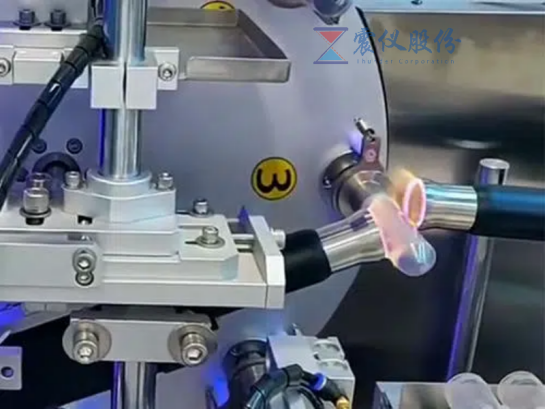
When using high-density plasma, the ion density can be high enough to cause significant sputtering of the deposited film; A simple direct current discharge can be easily generated between two conductive electrodes at a temperature of several degrees Celsius, and may be suitable for the deposition of conductive materials. However, the insulating film will quickly extinguish this discharge during deposition. More commonly, excitation is achieved by applying an alternating current or radio frequency signal between the electrode and the conductive wall of the reaction chamber, or between two cylindrical conductive electrodes facing each other
Plasma deposition technology is a process that utilizes a plasma environment to deposit materials. By activating reactants with high-energy plasma, chemical reactions or physical deposition occur on the surface of the substrate, forming ultra-thin, uniform, and high-performance thin films. At present, this technology is widely used in semiconductor, optical, electronic, medical and other fields.
Plasma deposition technology can achieve material deposition through the following methods:
1. Physical process: High energy particles (such as ions and electrons) in the plasma bombard the target material, causing its atoms or molecules to sputter onto the substrate surface for deposition.
2. Chemical process: Plasma activates reactive gases (such as methane and silane) to decompose into active functional groups, which undergo chemical reactions on the surface of the substrate to produce solid products.
Low temperature operation: Compared with traditional chemical vapor deposition (CVD), plasma deposition can be performed at lower temperatures and is suitable for temperature sensitive substrates.

The multifunctionality of plasma deposition technology enables it to adapt to the deposition needs of various materials. The advantages of plasma deposition technology are as follows:
1. High deposition rate: The high energy of plasma can accelerate chemical reactions, thereby accelerating the deposition rate.
2. High film quality: capable of achieving high-purity, uniform, and dense film deposition, which can enhance the adhesion, uniformity, and density of the film.
3. Material diversity: can be used to deposit a variety of materials, including metals, ceramics, polymers, and composite materials.
4. Coating complex shapes: It can uniformly coat complex three-dimensional surfaces, suitable for applications that require precise and uniform coating.
Plasma deposition technology is applicable to various materials, including metal materials such as metal films, ceramic materials, semiconductor materials such as semiconductor devices and thin-film solar cells, composite materials, polymer materials. Plasma deposition technology can not only form coatings on polymer surfaces to improve their surface properties such as hydrophobicity and antistatic properties, but also be widely used in fields such as electronics, optics, mechanics, and biomedical sciences.
2021-09
The above is about the principle of optical lens using···
2025-04
Application of plasma cleaning equipment in inkjet pri···
2021-08
In order to solve the problem of light pollution and···
2021-10
The term “spraying machine” covers more fields, and in···
2025-06
Plasma cleaning is an ideal choice for any manufacturi···